



How to Choose the Right AI for Your Business
Learn how to choose the right AI for your business. A practical, no-nonsense guide for non-technical business owners. Updated for 2025.
 Iranthi Gomes · CEO & Co-Founder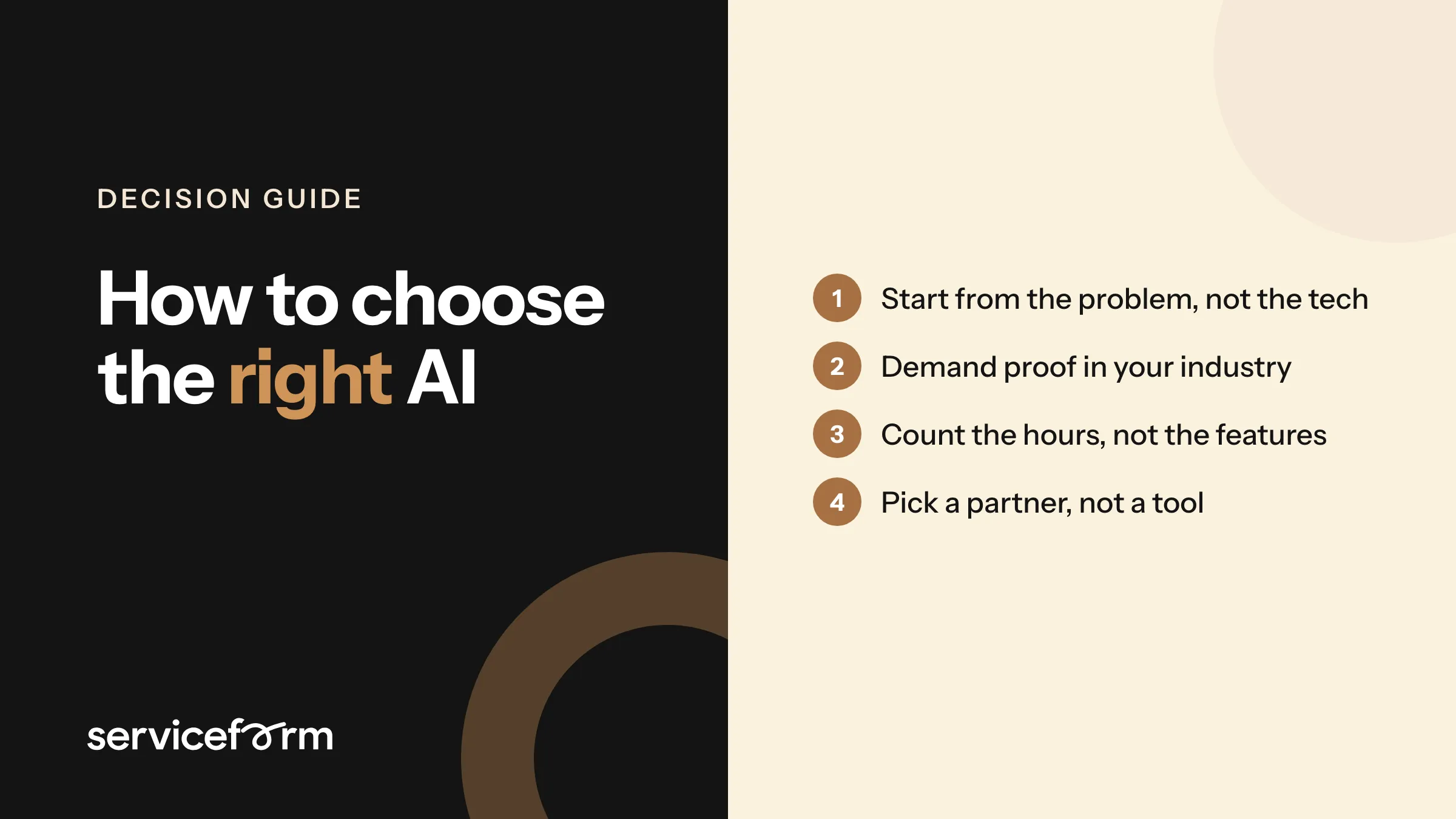
Quick answer: Don’t start with the tool, start with the problem. Pick the one task that costs you the most time or money, then choose AI that solves exactly that and shows real customer results. Ignore demos built by engineers who’ve never run a business. For lead capture and customer service, Serviceform’s Mira is a safe default: live on 1,500+ websites across 20+ countries, in 95+ languages, done-for-you from €299/month.
The 37-Tool Problem
My inbox currently has demos from 37 different AI companies. Sound familiar?
Everyone’s selling AI these days. Your LinkedIn is full of it. Your competitors are posting about it. And at least once a week, someone tells you that AI will “transform” your business.
Here’s the thing: most of it won’t help you. Most AI tools are built by engineers who’ve never run a business. They’re clever, but they don’t actually help you sell more or save time.
This guide will help you cut through the noise in about 10 minutes.
First, Forget About AI for a Second
Seriously. Before you look at any tool, do this exercise:
The Friday 5pm Test
It’s Friday at 5pm. You’re exhausted. What’s the ONE thing you wish wasn’t your problem anymore?
Be specific. Not “I want to grow my business.” That’s too vague. More like:
- “I lose leads because no one answers the phone after 6pm”
- “My team spends 3 hours a day answering the same questions”
- “I can’t find anything in our messy SharePoint”
- “Our website gets traffic but barely any enquiries”
Write your thing down. We’ll come back to it.
The 4 Types of Business AI (Actually Useful Edition)
Forget all the jargon. There are basically four types of AI that matter for your business:
1. Chatty AI (Talks to Your Customers)
This is AI that has conversations – on your website, WhatsApp, SMS. It answers questions, captures leads, books appointments.
Good for: Customer service, lead capture, appointment booking
Examples: Mira AI, Intercom, Drift
2. Brainy AI (Analyses Your Data)
This AI looks at numbers and finds patterns. Sales forecasts, customer behaviour, market trends.
Good for: Understanding what’s happening in your business
Examples: Tableau with Einstein, Power BI, custom solutions
3. Busy AI (Automates Boring Tasks)
This AI does repetitive work: data entry, invoice processing, report generation.
Good for: Freeing up your team from grunt work
Examples: Zapier, UiPath, various automation tools
4. Creative AI (Makes Content)
This AI writes, designs, creates. Blog posts, images, code, presentations.
Good for: Marketing teams, content creation
Examples: ChatGPT, Claude, Midjourney, Canva AI
Quick quiz: Look at your Friday 5pm problem. Which type of AI would solve it?
The BS Detector: 5 Questions to Ask Any AI Vendor
Before you sit through another demo, ask these:
1. “What happens when it gets something wrong?”
AI makes mistakes. Good vendors have human handoff built in. Bad vendors pretend their AI is perfect.
Red flag: “Our AI is 99% accurate” (everyone says this)
Green flag: “Here’s how we handle edge cases and escalations”
2. “Can I see it work with a company like mine?”
Case studies matter. But “we work with Fortune 500 companies” doesn’t help if you’re a 20-person business.
Red flag: Only giant company logos
Green flag: Specific examples from your industry and size
3. “What’s the real total cost?”
Some tools show you £200/month and then charge extra for everything useful. Others are genuinely all-in.
Red flag: “Custom pricing” on everything
Green flag: Clear pricing page with what’s included
4. “How long until I see results?”
If someone says “6-12 months,” run. Good AI tools show value in weeks, not years.
Red flag: Long implementation with lots of consulting
Green flag: “Most customers see results in 2-4 weeks”
5. “Will this still work when you get acquired/go bust?”
Ask about data ownership. Can you export your data? What happens if they disappear?
Red flag: Vague answers about data portability
Green flag: Clear data export and ownership policies
The 3 Biggest Mistakes I See Business Owners Make
Mistake 1: Buying “The Best” Instead of “The Best for You”
Enterprise AI for a 10-person company is like buying a Ferrari for your weekly shop. Impressive, completely impractical.
The best AI is the one that solves YOUR specific problem at a price you can afford.
Mistake 2: Starting Too Big
“Let’s implement AI across all departments!” No. Start with one problem, one tool, one team.
Pilot it. Prove it works. Then expand.
Mistake 3: Not Involving the Team Who’ll Actually Use It
Your frontline staff know where the real problems are. Include them early. If they don’t adopt it, it doesn’t matter how good the tech is.
A Simple Framework: The AI Selection Checklist
Before committing to any AI tool, tick these boxes:
- Problem clarity: Can you explain the problem in one sentence?
- ROI math: Will it save/earn 3x what it costs?
- Integration: Does it work with your current setup?
- Support: Can you reach a human when things break?
- Trial: Can you try before you commit?
If you can’t tick all five, keep looking.
What We’d Recommend (Honestly)
I work at Serviceform, so I’m biased. But here’s genuinely what I’d suggest:
If your problem is talking to customers 24/7:
Conversational AI like Mira AI. We built it specifically for businesses that lose leads outside working hours.
If your problem is understanding your data:
Analytics AI. Start with what’s built into tools you already use before buying something new.
If your problem is creating content:
Creative AI like ChatGPT or Claude. Try the free versions first.
If your problem is repetitive tasks:
Automation tools like Zapier. Often cheaper than full AI solutions.
Universal advice: Start with ONE. Master it. Then expand.
Still Not Sure?
We’ve helped 500+ businesses figure this out. Happy to chat for 15 minutes – no demo, no pitch, just honest advice about what might work for you.
Book a call and bring your Friday 5pm problem. Let’s solve it together.